CareTV Reference Server Requirements
Five-Year High-Performance File / Index / Media Server · Global reference architecture · August 16, 2026
This server is intended to become a repeatable CareTV reference appliance for homes, caregivers, schools, labs, and assistive-technology deployments. It must be fast enough to remain useful for at least five years and simple enough that the CPU/motherboard arrive installed and tested.
Current purchasing principle: do it correctly once. A total server cost above $3,000 is acceptable if the cost is genuinely required to satisfy the long-term specification and eliminates foreseeable near-term obsolescence or labor.
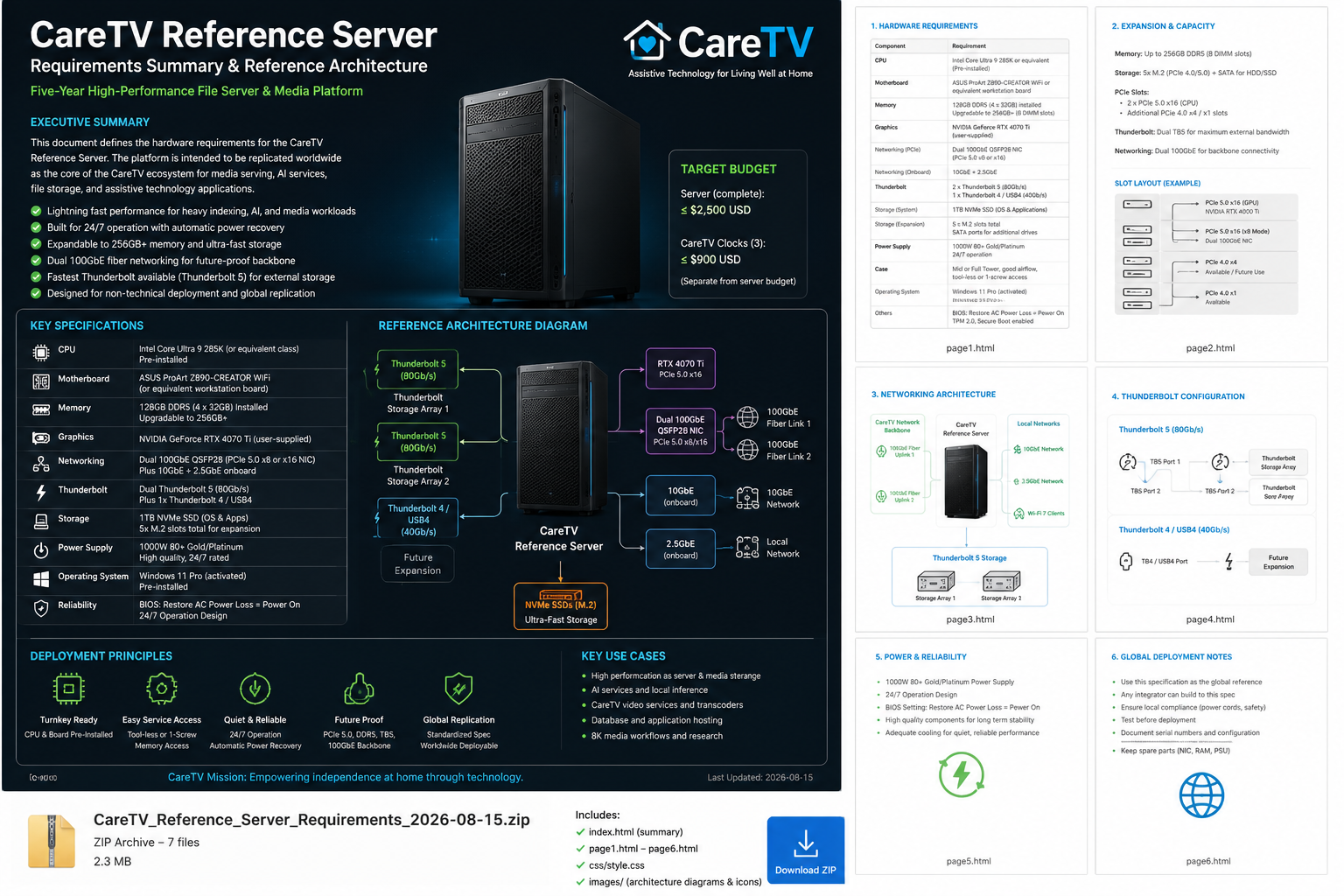
Hard requirements
| Area | Requirement |
|---|---|
| Deployment model | Turnkey tower/workstation. CPU and motherboard must arrive installed and tested. No CPU installation by the end user. |
| Service life | Designed as the primary CareTV file/index/media server for at least five years. |
| Memory | 128GB DDR5 installed initially. Prefer a platform supporting at least 192GB–256GB for later expansion. |
| CPU | Current-generation high-performance workstation/desktop CPU suitable for heavy indexing, database activity, file serving, local AI/video services, and multiple simultaneous CareTV workloads. |
| System storage | At least 1TB fast NVMe SSD for Windows, indexes, databases, applications, caches, and CareTV services. Existing external JBODs provide bulk storage. |
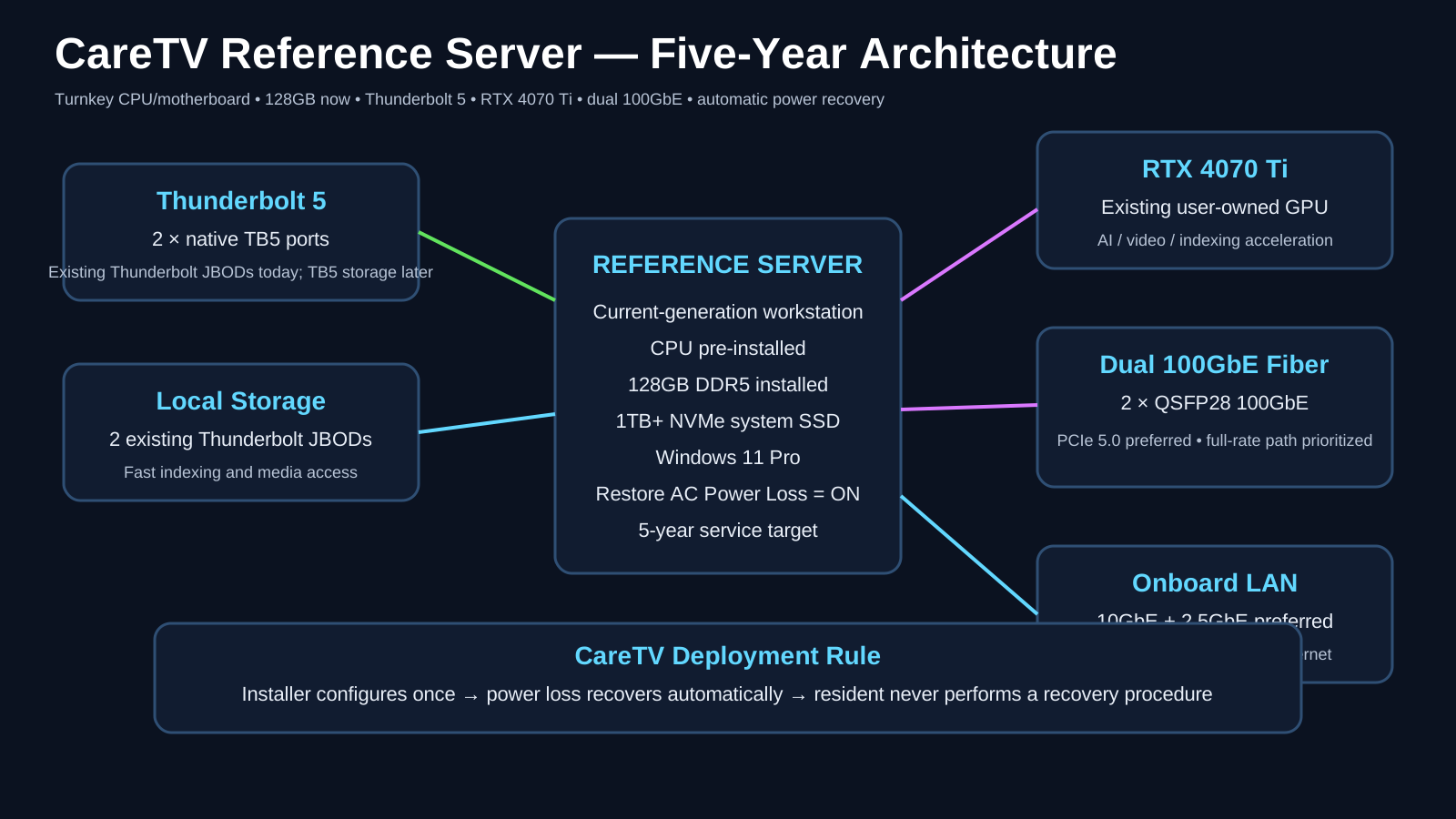
| Thunderbolt | Fastest current mainstream generation: Thunderbolt 5. Prefer at least 2 native TB5 ports. Existing Thunderbolt JBODs must remain usable; future TB5 storage must not be blocked by an obsolete host. |
| GPU | Physical, electrical, PSU and cooling capacity for the existing RTX 4070 Ti. No new GPU purchase required initially. |
| 100Gb QSFP28 fiber networking | Support a dual-port 100GbE QSFP28 fiber NIC with 2 × QSFP28-class 100Gb ports. PCIe Gen5 host connectivity is preferred for a five-year build. |
| Ordinary networking | 10GbE RJ-45 copper Ethernet onboard preferred, plus ordinary RJ-45 copper Ethernet for management and compatibility. |
| PCIe expansion | Enough usable full-length expansion capacity to operate the RTX 4070 Ti and dual-port 100Gb NIC simultaneously without making one device unusably bandwidth-limited. |
| Power supply | High-quality PSU with comfortable margin for CPU + RTX 4070 Ti + 100Gb NIC + expansion; roughly 1000W-class is preferred depending on final CPU/GPU configuration. |
| Power recovery | BIOS/UEFI must support Restore on AC Power Loss = Power On. The server must cold-boot automatically when utility power returns. |
| Operating system | Windows 11 Pro, activated, with remote administration and unattended CareTV services. |
| Maintenance | Case access should be tool-less or nearly tool-less. RAM installation is acceptable only if it requires no more than a simple panel release / approximately one screw and normal DIMM insertion. |
| Global replication | The public CareTV specification should define required capabilities rather than depend forever on one disappearing retail SKU. |
Reference I/O architecture
Why older bargain workstations are rejected
An inexpensive older workstation can provide large amounts of RAM and many PCIe slots, but it can immediately compromise the five-year objective through PCIe 3.0, Thunderbolt 3, DDR4, older CPUs, inefficient power use, and reduced future storage/network expansion.
For this reference machine, purchase price alone is not the optimization target. Total five-year usefulness, installer labor, reliability, expansion capacity, and repeatability are more important.
Mandatory Network Interface Physical-Medium Labeling Rule
Hard documentation requirement: every CareTV hardware recommendation, architecture diagram, equipment list, port description, and network-interface reference must explicitly state the physical medium. The reader must never be expected to infer whether a port is copper or fiber.
| Do not write only | Write instead |
|---|---|
| 10GbE | 10GbE RJ-45 copper Ethernet — or 10GbE SFP+ fiber, whichever is actually meant. |
| 25GbE | 25GbE SFP28 fiber when referring to SFP28 optical/fiber networking. |
| 100GbE | 100GbE QSFP28 fiber when referring to QSFP28 optical/fiber networking. |
| Ethernet port | RJ-45 copper Ethernet port when the connector accepts ordinary Cat6/Cat6A copper cable. |
This wording must also be used in diagrams, shopping recommendations, installation guides, and educational explanations. When a device contains both media types, list them separately—for example: 2 × 100GbE QSFP28 fiber + 1 × 10GbE RJ-45 copper Ethernet.
Performance priorities
↓
128GB RAM
↓
HEAVY FILE / DATABASE INDEXING
↓
THUNDERBOLT JBOD MEDIA STORAGE
↓
100GbE QSFP28 FIBER CARETV BACKBONE
↓
RTX 4070 Ti LOCAL GPU SERVICES
Storage philosophy
The reference server does not need to repurchase a large NAS chassis merely to obtain drive bays. The current deployment already owns external Thunderbolt JBOD enclosures. The server therefore prioritizes CPU, memory, NVMe index/cache performance, Thunderbolt 5 host I/O, GPU expansion, and 100Gb QSFP28 fiber networking.
Bulk storage can remain in replaceable external arrays while the CareTV server provides the filesystem, index, database, API, media, automation, and local-compute layer.
Worldwide deployment principle
The reference design should be published as an open specification. Integrators worldwide may substitute equivalent current hardware so long as it passes the same acceptance requirements.
CareTV should separately publish a Tested Reference Build: the exact machine, RAM, NIC, GPU, OS settings, Thunderbolt storage, power-recovery settings, and benchmark/test results that were physically verified.
Acceptance tests before CareTV certification
- Cold AC-loss test: remove AC, restore AC, server boots with no button press.
- Windows and CareTV services start automatically.
- Both Thunderbolt storage arrays reconnect automatically.
- 100Gb QSFP28 fiber network interface initializes reliably after repeated boots.
- RTX 4070 Ti remains stable under simultaneous CPU/storage/network load.
- Heavy indexing test demonstrates sustained responsiveness without memory pressure.
- Repeated reboot and power-loss cycles produce no manual recovery requirement.
- Document BIOS version, drivers, NIC firmware, RAM configuration, PSU, slot layout, and all CareTV service settings for global replication.
Budget policy
The working target began below $2,500 for the server, but the final rule is more important:
If exceeding $3,000 is genuinely necessary to obtain the required five-year architecture—128GB memory, current CPU/platform, Thunderbolt 5, NVMe, RTX 4070 Ti compatibility, dual 100Gb fiber capability, strong PSU, and turnkey assembly—buy the correct machine once rather than purchasing an immediately obsolete compromise.
The three CareTV Room Clock appliances are a separate approximately $900 deployment budget.
Filename: caretv-reference-server-requirements-five-year-global-deployment-2026-08-16-v002.html
Public permalink: https://8k.art/beta/_daily-builds/2026-08-16/caretv-reference-server-requirements-five-year-global-deployment-2026-08-16-v002.html
Daily-build folder: https://8k.art/beta/_daily-builds/2026-08-16/
Illustrations: caretv-reference-server-requirements-illustrations/