Automatically Updated YouTube Grids for Memory Care
A nearly free, browser-based way to give people with Alzheimer’s, dementia, brain injury, or severe spatial-memory impairment one-tap access to familiar videos, family media, music, help, and TV controls.
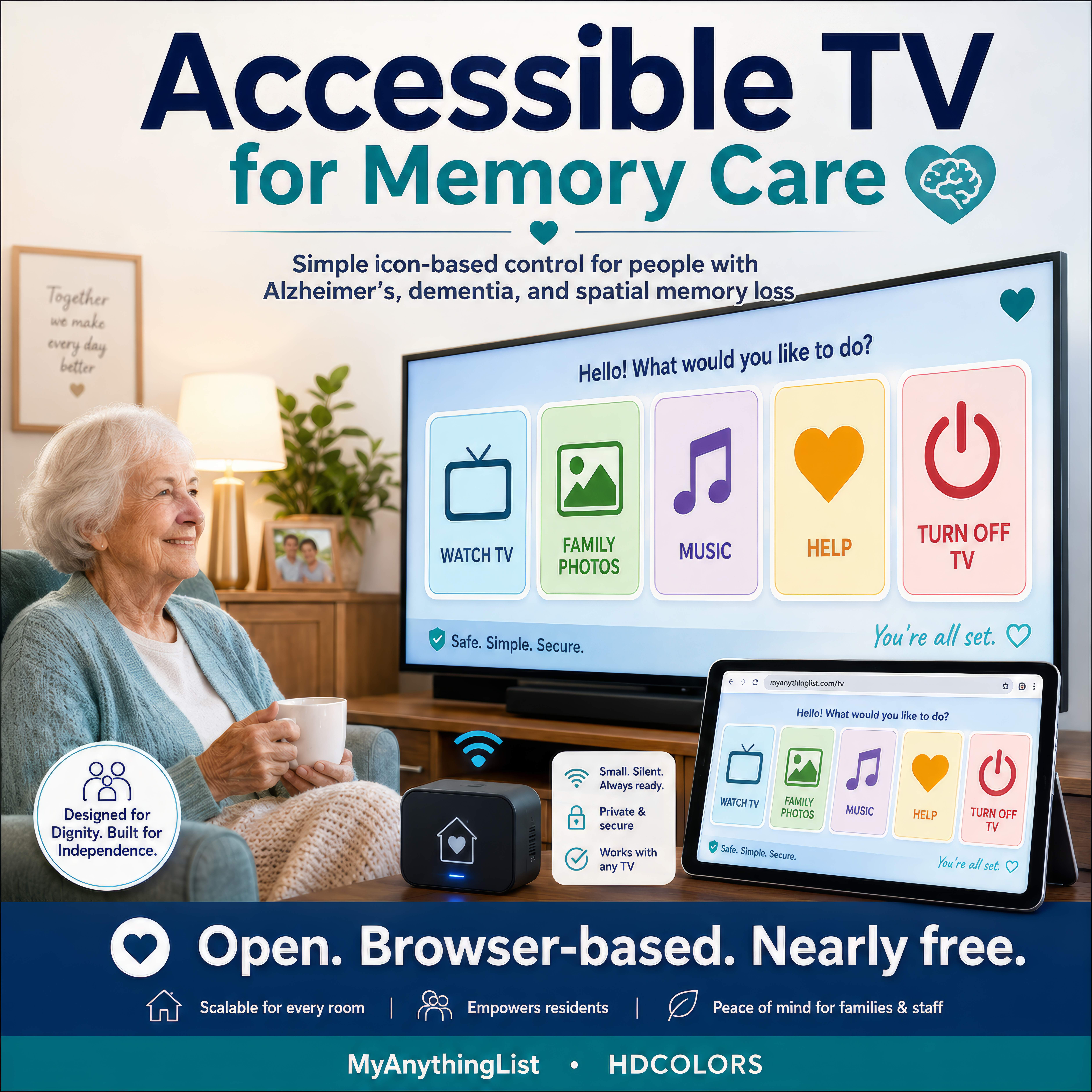
Who this is for
This proposal is addressed to large-scale partners and high-influence organizations that can help deploy simple, humane accessibility technology at mass scale.
Technology platforms
Apple, Google, Amazon, Samsung, Roku, LG, Microsoft, YouTube, OpenAI, smart-home platforms, device makers, and browser teams.
Healthcare and care networks
Memory-care facilities, convalescent homes, assisted-living chains, rehab centers, hospital discharge planners, occupational therapists, and senior-care technicians.
Funders and advocates
Healthcare foundations, disability-rights organizations, philanthropists, accessibility researchers, caregiver networks, and open-source developers.
The problem: modern TV assumes memory
Many people with Alzheimer’s, dementia, temporal-lobe injury, stroke damage, medication-related impairment, or spatial-memory loss cannot reliably navigate smart-TV menus. Every home screen, app row, input selector, advertisement wall, and remote-control sequence becomes a maze.
The issue is not that the person “can’t use a remote.” The issue is that the remote and the smart-TV interface were not designed for their brain.
The solution: a visual grid of familiar choices
MyAnythingList can turn ordinary URLs into a visual media grid of links, videos, images, and QR codes. The uploaded app itself describes this as a single-file web application that can run locally or online and convert a simple text playlist into a visual grid. It also supports high-resolution export presets, including 8192×4320 DCI 8K for media-wall and demonstration work.
For the patient, the experience is simple: tap the picture. Behind that picture, a room controller, smart plug, YouTube link, or macro can do the complicated work.
Why YouTube direct links are powerful for care
For many memory-care users, direct YouTube videos and playlists can be simpler than navigating a live-TV app. A caregiver can curate familiar content: favorite news clips, familiar shows, music, family messages, church services, relaxation videos, or facility announcements.
YouTube Premium can remove YouTube-served ads from many videos and adds features such as background playback and offline downloads. YouTube also offers Premium Lite in some markets, with ad-free viewing for most YouTube and YouTube Kids videos, but fewer features than the full plan. For care settings, this can reduce interruptions and confusion dramatically.
Sources: YouTube Premium benefits, YouTube Help: why ads or promotions may still appear, and YouTube Premium Lite announcement.
Automation architecture
The patient-facing page should stay public and simple. The automation should happen privately on a VPS or room controller.
Patient / resident opens a browser page
        ↓
MyAnythingList reads a public plain-text playlist from S3
        ↓
The page displays large YouTube thumbnails and support buttons
        ↓
A private VPS cron job updates the public playlist automatically
        ↓
The caregiver never has to hand-pick URLs every day
Recommended production flow
GoDaddy / LAMP VPS
  ├─ PHP generator script
  ├─ YouTube Data API or YouTube RSS fetcher
  ├─ rules for latest channel video / latest matching episode / fixed videos
  ├─ writes mom-tv-latest.txt
  ├─ uploads to S3
  └─ cron job runs every 15–60 minutes

S3 / CloudFront
  └─ public plain-text MyAnythingList URL list

MyAnythingList
  └─ renders the latest visual grid in any browser
Tile types the generator should support
| Tile type | What it does | Care example |
|---|---|---|
specific_video | Always uses one YouTube video ID. | A favorite clip that reliably calms or orients the resident. |
latest_channel_video | Uses the newest upload from a YouTube channel. | Latest MeidasTouch or PBS NewsHour upload. |
latest_matching_video | Uses the newest upload whose title matches keywords. | Latest Rachel Maddow, Lawrence O’Donnell, Nicolle Wallace, or The View segment. |
latest_playlist_item | Uses the newest video in a YouTube playlist. | Latest episode playlist from a show or family playlist. |
search_url | Opens YouTube search results for a phrase. | Fallback: “Rachel Maddow latest.” |
static_url | Opens any normal URL. | Family photos, facility calendar, dining menu. |
local_macro | Calls a room controller endpoint. | Turn TV off, reset TV, volume up/down, help alert. |
Common categories to automate
News and commentary
Latest MSNBCRachel MaddowLawrence O’DonnellNicolle WallaceChris HayesThe ViewPBS NewsHourDemocracy NowMeidasTouch
Comfort content
Favorite old clipsClassic TVNatureBirdsGardensRelaxing sceneryMusic from her eraFunny videos
Family content
Family photosFamily videosMessages from KenGrandkidsBirthday videosHoliday videosComfort slideshow
Facility and care actions
Today’s activitiesDining menuExercise classChapel serviceFacility announcementsCall nurseI need helpI’m OK
Example public MyAnythingList output
The public file should remain simple. It can contain layout commands and URLs only. All private logic, API keys, and selection rules stay on the VPS.
#_GRID=3
#_ShowQR=false
#_ShowURLs=false
#_HeaderText=Mom's TV Favorites
#_FooterText=Large familiar choices. Updated automatically.

https://www.youtube.com/watch?v=LATEST_RACHEL_VIDEO
https://www.youtube.com/watch?v=LATEST_RACHEL_PODCAST
https://www.youtube.com/watch?v=LATEST_THE_VIEW
https://www.youtube.com/watch?v=LATEST_LAWRENCE
https://www.youtube.com/watch?v=LATEST_MEIDASTOUCH
https://family.example.com/photos
http://mom-tv.local:8787/help
http://mom-tv.local:8787/tv-off
Example PHP configuration model
This is the kind of configuration we can build locally on a laptop, then deploy as a cron job on a LAMP VPS.
<?php
$tiles = [
  [
    "label" => "Rachel Latest Video",
    "type" => "latest_matching_video",
    "channel_id" => "UC_CHANNEL_ID_HERE",
    "include" => ["Maddow"],
    "exclude" => ["Shorts", "#shorts"],
    "fallback" => "https://www.youtube.com/results?search_query=Rachel+Maddow+latest"
  ],
  [
    "label" => "Rachel Podcast",
    "type" => "latest_matching_video",
    "channel_id" => "UC_CHANNEL_ID_HERE",
    "include" => ["podcast", "Rachel Maddow"],
    "exclude" => ["Shorts", "#shorts"],
    "fallback" => "https://www.youtube.com/results?search_query=Rachel+Maddow+podcast+latest"
  ],
  [
    "label" => "The View",
    "type" => "latest_matching_video",
    "channel_id" => "UC_CHANNEL_ID_HERE",
    "include" => ["The View"],
    "exclude" => ["Shorts", "#shorts"],
    "fallback" => "https://www.youtube.com/@TheView"
  ],
  [
    "label" => "Favorite Clip",
    "type" => "specific_video",
    "video_id" => "VIDEO_ID_HERE"
  ],
  [
    "label" => "Family Photos",
    "type" => "static_url",
    "url" => "https://example.com/family-photos"
  ],
  [
    "label" => "Turn Off TV",
    "type" => "local_macro",
    "url" => "http://mom-tv.local:8787/tv-off"
  ]
];
Why this can scale
A facility technician can configure one room, then copy the pattern to every room. The visible interface remains a browser page with large icons. The care team can update the playlist without retraining the patient. Family members can contribute familiar videos and photos. A small controller can handle device-specific actions.
This is not just a remote replacement. It is a recognition-based access layer for people who cannot reliably use recall-based interfaces.
Public message
We can build a system where families and facilities maintain simple, automatically updated pages of familiar media. A resident can see a recognizable thumbnail and tap it. The system can open the latest episode, a favorite video, a family message, music, or a help function.
We want this to be nearly free because the people who need it most should not be priced out. The internet already has the devices, browsers, video platforms, smart plugs, and low-cost mini computers. What is missing is the humane interface layer.
This should exist. It should be open, browser-based, easy to deploy, and inexpensive enough to reach every room where it is needed.
Notes and source links
- MyAnythingList app concept and uploaded build: plain-text playlists become visual media grids; high-resolution presets include DCI 8K.
- YouTube Data API: playlistItems.list can retrieve items from a channel uploads playlist and has a low quota cost.
- YouTube API implementation guide describes retrieving a channel’s uploads playlist through
channels.listwithcontentDetails. - YouTube Premium benefits include ad-free viewing benefits, offline downloads, and background play depending on plan and app context.
- YouTube Help: ads on Premium explains that some creator-added promotions, podcast branding, Primetime Channels, or live events may still show promotions or ads.
- YouTube Premium Lite was introduced as a lower-priced way to watch most videos ad-free in supported markets.