One old waiter photo became a map of a life, a technical career, an AI experiment, and an accessibility requirement.
This version goes beyond “here are some images.” The source photo, the later AI transformations, the fictional HeyGen avatar, the video, the playlist, the video title, the description/comments, and Ken’s present-day explanation all belong to one connected record.
The real starting point: Ken as a young waiter in Key West
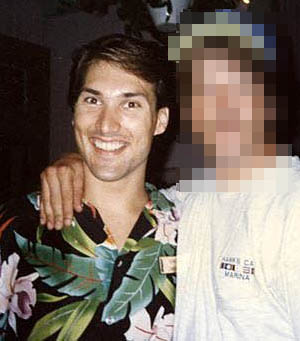
https://8k.art/beta/_images/Ken-as-Waiter.jpg
Ken remembers that people sometimes used the “Barbie and Ken” association to remember his name. The irony is important: other people had an easy mnemonic for him, while he describes having great difficulty remembering other people’s names and faces once they were outside the context in which he knew them.
From restaurant work to INFOCALL: an early version of the same design instinct
Ken describes being hired from that waiter job by INFOCALL in the early 1990s. He became Technical Director and worked with Macromedia Authorware on early Windows systems. INFOCALL built standing airport telephone/kiosk systems intended to connect travelers with food, transportation and hotels.
The continuity with today’s CareTV work is striking: the technology is completely different, but the design problem is similar. Hide technical complexity and expose a simple human intention. In the airport kiosk era the intention might have been “hotel” or “transportation.” Today it is “show the front door,” “call Grandma,” “what did I say an hour ago?” or “publish this.”
The same historical photo became raw material for modern AI media
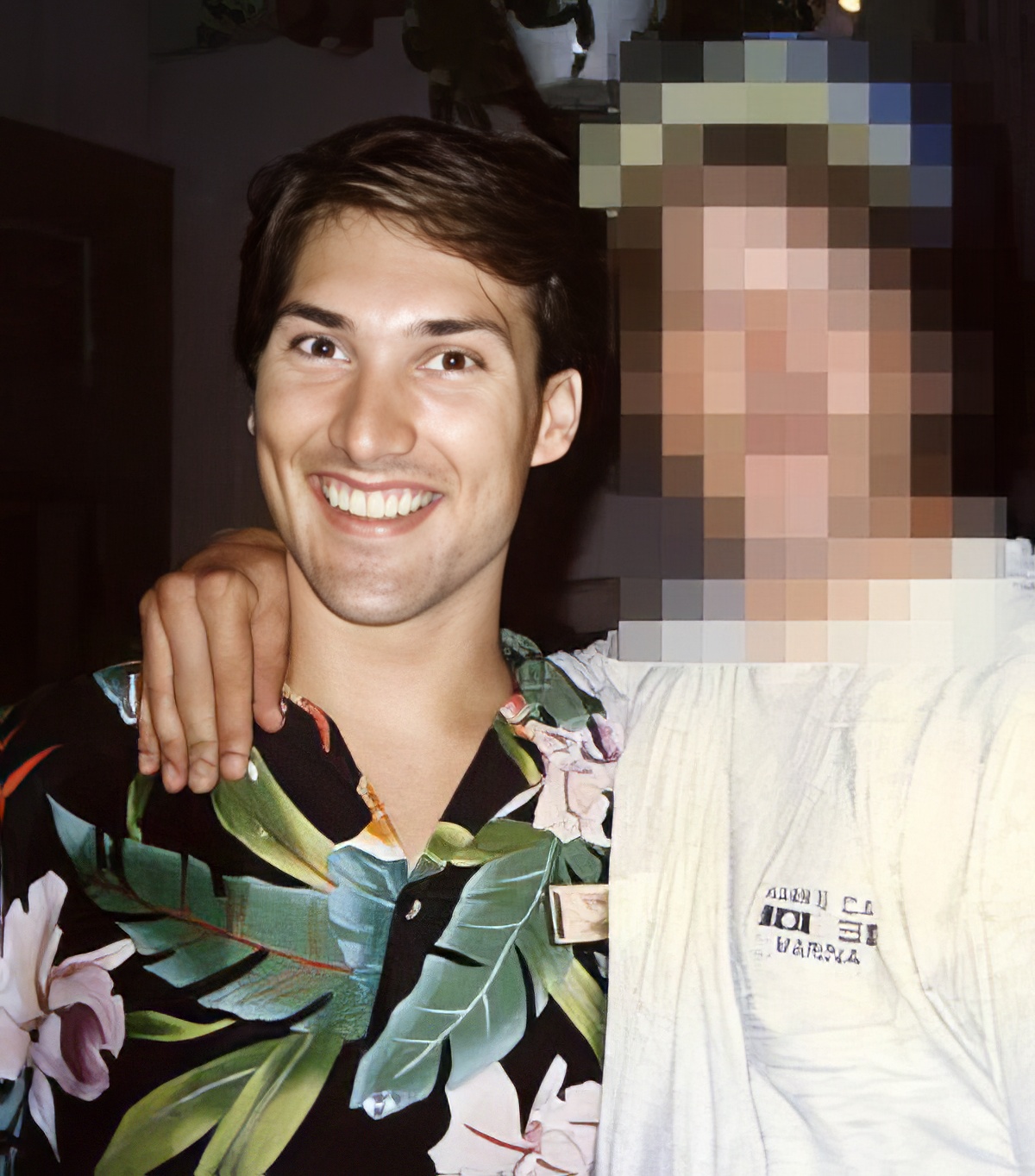
https://8k.art/beta/_images/Ken-as-Waiter-2.jpg

https://8k.art/beta/_images/Fictional-Ken-as-Waiter-AI-Avatar.png
Friendly context: This is the fictional avatar video Ken supplied as part of the same story. The video is important not merely as an animation, but because it places a synthetic “alternate reality” version of his younger self inside a public autobiographical archive.
https://8k.art/beta/_images/Fictional-Ken-as-Waiter-AI-Avatar-Video.mp4
YouTube is part of the artifact, not just a place where the MP4 happens to live
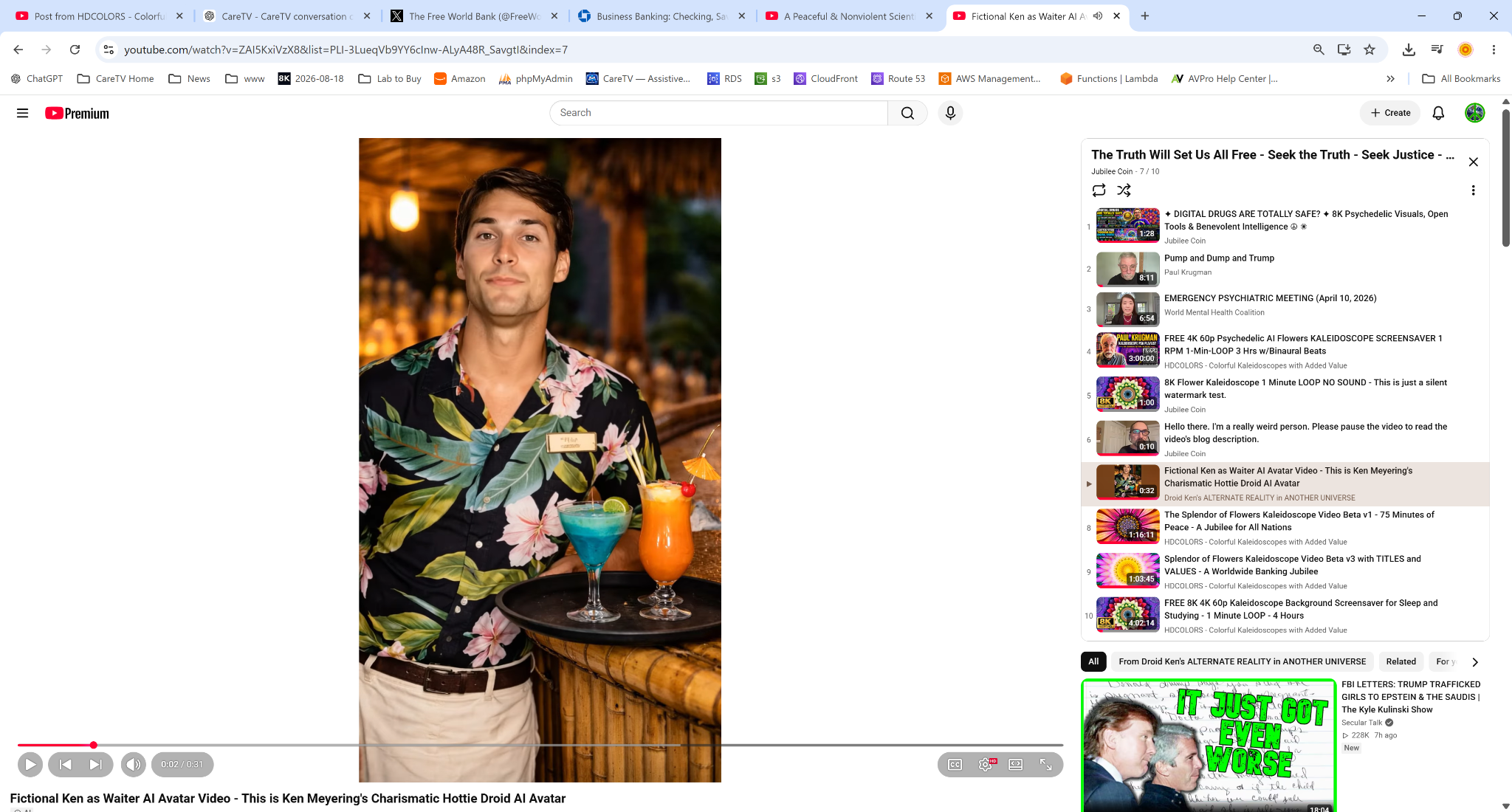
The visible video title is:
The visible channel/identity framing under that playlist item is:
The visible playlist title begins:
Those labels matter. They tell the reader that the synthetic avatar is being framed as fiction/alternate reality rather than quietly passed off as historical documentary footage.
Exact video and playlist URL
https://www.youtube.com/watch?v=ZAI5KxiVzX8&list=PLI-3LueqVb9YY6cInw-ALyA48R_SavgtI
Exact playlist embed
That limitation is itself part of the design requirement: a proper personal archive should ingest the video, title, description, comments, playlist membership, timestamps, thumbnails, captions and local commentary as one related object rather than forcing a person to remember which parts lived only inside a platform UI.
This is also a disability story about context-dependent memory
Ken says that even when he was young, he had difficulty forming friendships partly because he could not reliably remember names and faces outside their original context. That makes this historical photo unusually relevant to today’s CareTV project: the same person who once worked in a high-social-contact restaurant environment now describes building a machine-assisted external memory because context can disappear faster than he can preserve it.
The waiter photo therefore connects several decades:
- social memory difficulty when young;
- technical work at INFOCALL building simplified information interfaces;
- decades of PC and multimedia experience;
- modern AI image restoration and avatar generation;
- YouTube as a public autobiographical archive;
- CareTV’s current 24/7 audio/video/transcript indexing goal.
What YouTube is visibly permitting here
As shown in the supplied YouTube screenshot, the fictional avatar video is being hosted and presented inside Ken’s public playlist with an explicit fictional/alternate-reality framing. That does not mean YouTube has endorsed every idea expressed in the video, description or comments. It does mean the platform is currently carrying the work as part of the public archive visible in the supplied screen.
That distinction matters. The interesting point is not “YouTube agrees with Ken.” The interesting point is that a mainstream platform can host autobiographical material that deliberately mixes real history, synthetic media, speculative fiction, political commentary and technical experimentation—as long as the reader is given enough context to understand what kind of thing they are seeing.
Why the assistant’s previous standalone-image response was such a serious miss
The assistant saw a rich chain of historical evidence, AI transformations, video, playlist context and autobiographical explanation—and reduced the response to one newly generated portrait.
The generated portrait was not inherently the problem. The problem was severing it from the original photo, exact URLs, video, playlist, comments/description context and the user’s explanation of why those things matter.

Permanent CareTV / 8k.art archival rule
For every externally hosted media object: preserve the original URL visibly; ingest the media when authorized; preserve title, description, captions, comments, playlist/collection membership, timestamps and surrounding conversation; distinguish source material from AI enhancement and fiction; and attach friendly explanatory context.
That is what “AI-indexed external memory” means in practice. It is not just OCR, transcription or file storage. It is preservation of relationships.
7. The missing paragraph explains why continuous screen memory matters
During the creation of this document, another failure occurred in real time. ChatGPT displayed a substantive progress paragraph while Ken was reading it. Then the interface changed and that visible text disappeared. The final response preserved some of its meaning, but the exact on-screen experience was no longer available to Ken from the application itself.
This is not an abstract archival problem. Ken was actively reading information that had already appeared on his screen. Once it disappeared, he could no longer rely on his own memory to reproduce it exactly. For someone deliberately using AI as an external-memory aid, that means an application can effectively remove part of the memory while it is being formed.
That incident creates a concrete CareTV requirement:
The local solution: continuous private full-screen capture
The planned CareTV screen-memory layer does not depend on ChatGPT, Windows, a browser, YouTube, X, Microsoft, or any other application preserving its own interface history. The workstation observes the screen locally because the pixels are already being displayed to the user.
FULL 8K DESKTOP
7680 × 4320 when that is the actual source
        ↓
OBS / libobs-based capture
        ↓
short rolling frame buffer in RAM
        ↓
continuous high-quality segmented archive
        ↓
OCR + machine vision
        ↓
window / application / URL / screen-state metadata
        ↓
timestamp synchronization
        ↓
room microphone + system audio + WordBeat transcript
        ↓
CareTV event index
This would have changed the incident completely. Instead of saying, “I remember that ChatGPT showed me a paragraph and then it vanished,” Ken could say:
CareTV could retrieve the exact screen frames from that moment, associate them with the speech and transcript occurring at the same time, and preserve the pixels as evidence. OCR could make the vanished paragraph searchable even if ChatGPT itself no longer retained it as a visible message.
Capture the screen before trying to understand it
The architecture should separate preservation from interpretation. The first obligation is to preserve what was actually displayed. Machine vision, OCR, summarization, object recognition, topic extraction and AI interpretation are derived layers that can improve later.
Preservation rule: keep the highest-fidelity practical local source first. Analysis can always be rerun. A vanished source cannot be reconstructed with certainty from a summary.
For short-term context, raw or minimally transformed frames can remain in a RAM ring buffer. The system does not need to hold twenty-four hours of uncompressed 8K video in memory. It only needs enough high-fidelity rolling context to capture what happened immediately before and after an event. Durable history can then be written as high-quality segmented recordings to local NVMe storage, with timestamps and checksums.
Audio and screen history become one timeline
The screen recorder is much more useful when synchronized with continuous room audio and speech recognition. If Ken says, “That paragraph is important,” while reading something on screen, CareTV should already know which screen state and which words were present at that timestamp.
19:34:12.420  screen frame
19:34:13.006  ChatGPT progress text visible
19:34:14.882  Ken: “That is exactly what I mean.”
19:34:17.115  screen content changes
19:34:17.203  prior paragraph no longer visible

CareTV relationship:
SCREEN + SPEECH + APPLICATION + URL + TIMESTAMP
                    ↓
               ONE EVENT
The important accessibility benefit is that Ken no longer has to notice the loss quickly enough to press Print Screen. The capture occurred before he knew he would need it.
“Show GPT my screen” becomes retrieval, not manual screenshotting
Once continuous capture is running, a command such as “COMPUTER, show GPT my screen” does not begin the recording. Recording was already happening privately. The command marks an event and selects the relevant context from the rolling buffer.
That allows CareTV to attach the current frame, several seconds of preceding screen history, nearby spoken commentary, the active application and URL, and the continuous transcript. The user does not name a screenshot, find a folder, upload a file, or remember what happened.
Private memory is different from public broadcast
This architecture is intended first as a private local memory system. Continuous private capture does not imply continuous public streaming. Public output must be a separate derivative path with its own approval, redaction and—where useful—broadcast delay.
PRIVATE SCREEN MEMORY
full local context
        │
        ├── private search / AI memory
        └── selected event
                 ↓
         privacy / secret scan
                 ↓
             APPROVAL
                 ↓
          PUBLIC DERIVATIVE
Passwords, PINs, API keys, financial details and other sensitive material may legitimately appear in the private screen archive. That is precisely why the private archive and public publishing path must remain separate systems.
This particular failure becomes the acceptance test
A useful regression test for CareTV is now obvious:
- Display a paragraph in an application.
- Allow the application to replace or remove it.
- Wait until the user realizes it is gone.
- Ask CareTV: “Show me what was on the screen before that disappeared.”
- Retrieve the original screen evidence and synchronized transcript without depending on the application that lost it.
This is the practical bridge between the waiter photograph at the beginning of this story and the CareTV architecture being built decades later. The challenge has always involved context. Today the computer finally has enough storage, bandwidth, machine vision, speech recognition and AI capability to preserve that context continuously instead of expecting Ken to remember it himself.
8. Before INFOCALL: Grassy Key, Dolphin Research Center, Hawks Cay Resort, and a one-room life on Duck Key
Ken adds an important correction and expansion to the early-1990s history preserved in this document. Before INFOCALL, he had moved to the Florida Keys and volunteered at the Dolphin Research Center in Grassy Key. He later worked as a waiter at Hawks Cay Resort on Duck Key.
At the time, Ken describes living very simply in a single cinder-block room in barracks-style housing on resort property, near a channel leading toward a marina. This was not the later image of a heavily equipped AI/media laboratory. It was a young person living in a small room, working as a waiter, while already carrying the technical interests that would soon pull him into computer-based interactive media.
Ken says he was hired directly from that waiter job by INFOCALL. INFOCALL was owned by a man named Joseph, who operated the company from a home office in Key West. Ken remembers the home as having a very private backyard filled with greenery and flowers, with a swimming pool.
Joseph hired Ken as INFOCALL's Technical Director. In that role, Ken worked with Macromedia Authorware on early Windows systems. Authorware functioned, in Ken's description, almost like a multimedia BASIC: a way to build interactive systems by combining graphics, logic, navigation, sound and user choices.
INFOCALL's project involved standing telephone/kiosk systems in airports that helped travelers connect with food, transportation and hotels. The system reduced a complicated local-information problem to a much simpler interaction for someone standing in an airport.
Why this matters to the present project
More than three decades later, the same product instinct appears again in CareTV:
- hide infrastructure complexity;
- present the human intention directly;
- connect people to information and services without requiring technical expertise;
- use multimedia as an interface rather than forcing the user to administer the underlying computer;
- make the system useful in the actual physical environment where the person is living.
The difference is philosophical as well as technological. INFOCALL was a privately owned commercial system. Ken's current goal is an open-source system whose basic knowledge, software patterns and documentation can be available freely to families, disabled people, caregivers, local installers, researchers and technically sophisticated observers.
Continuity: Grassy Key volunteer → Hawks Cay waiter on Duck Key → INFOCALL Technical Director in Key West → decades of multimedia/computer work → AI-generated media → CareTV and open assistive infrastructure.
This personal history also complicates simplistic ideas about employability or technical capability. Someone can have substantial technical skill and an unusually long history with computers and multimedia while simultaneously experiencing serious memory, executive-function and social-context limitations. The technical history and the disability history can both be true at the same time.